Foundation Settlement and Piering in Renton

Typical cost in Renton

  • Per pier$1,800 – $3,500+
  • One corner of the house, 3 to 4 piers$5,500 – $14,000+
  • One side of the house, 6 to 8 piers$11,000 – $28,000+
  • Whole house, 10 to 14 piers$18,000 – $49,000+

A house that has dropped at one corner, tilted or cracked is what this page is about, along with the piers and underpinning sometimes used to address it. It explains how settlement shows, how push and helical piers differ, what underpinning is and where each stops being the answer. Renton Foundation Repair does this work in Renton.

Work is in Renton, Kent and Tukwila. About 39 percent of Renton houses predate 1980, and what lies under a given footing is the first thing to ask.

Request a free quote
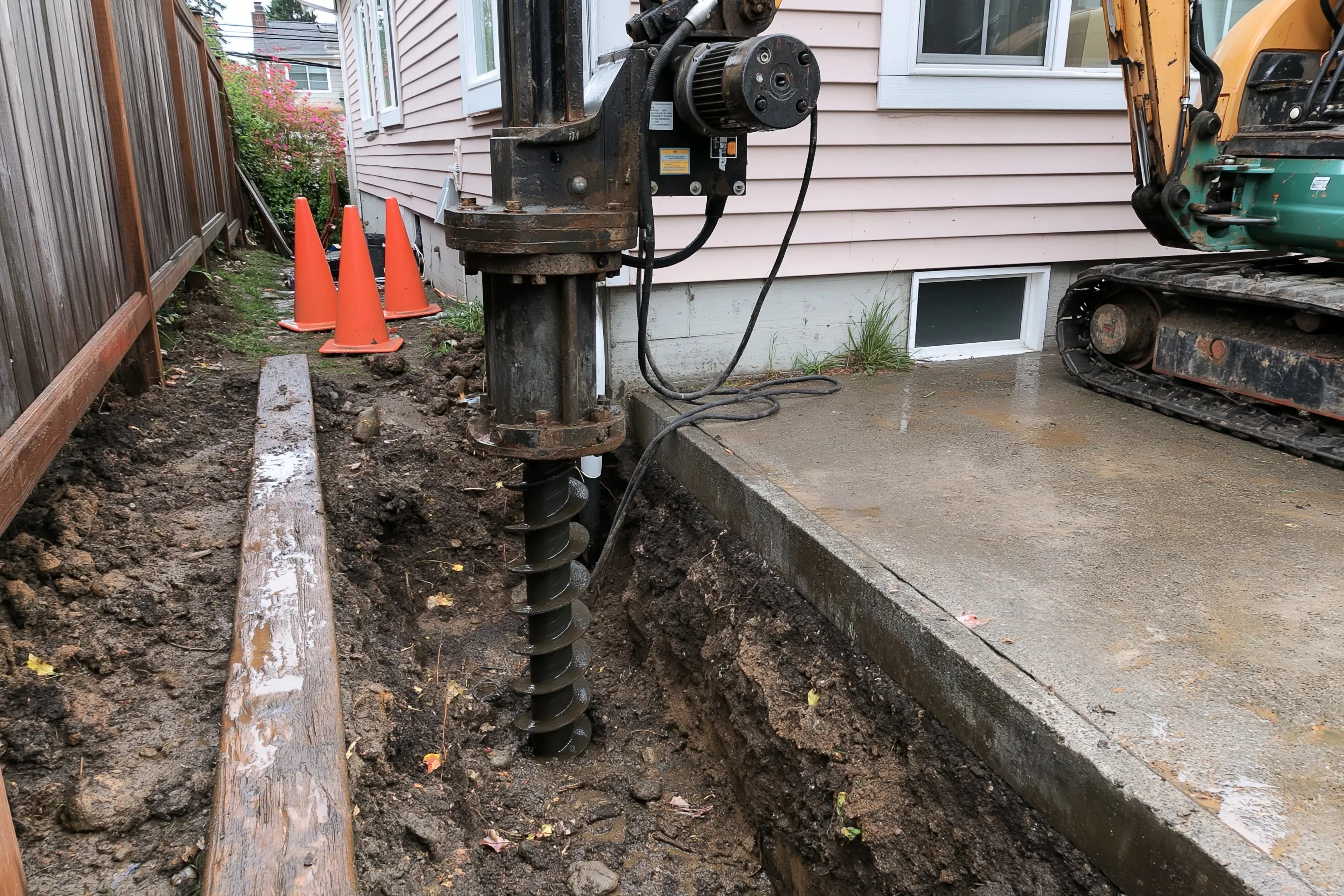
Hydraulic drive head and torque motor on a small compact excavator beside a house foundation, a steel helical shaft being turned into a narrow trench dug beside the footing, wet soil and orange cones

Push piers, helical piers and underpinning

Push piers

Push piers are pipe sections pressed under the footing one after another until they seat on rock or other firm material, the hydraulic ram reacting against the house itself. Misuse can crack the foundation and slab, HUD warns, and the cost only makes sense if firm ground lies fairly shallow.

Helical piers

Instead of being pushed, a helical pier is screwed down. Spiral plates on a steel shaft turn into the ground next to the footing, a bracket ties the shaft to that footing, and the torque measured as it goes in indicates what load the soil can carry. HUD adds that weak soil defeats the approach.

Underpinning

Underpinning means excavating beneath a settled wall to widen or deepen its footing. HUD calls the procedure dangerous and for experts, and wants it designed by an engineer so the footing suits the soil in both size and reinforcement. In silty or expansive soil it may not be an option.

Signs a house is settling

Check the floors, doors and cracks. A floor that falls away toward a corner, sticking doors and windows with wedge-shaped gaps, and cracks that taper all fit differential settlement. HUD reads tapering cracks near a bay window, porch or addition as piers or footings that are inadequate there.

Settlement, says HUD, generally builds up over time instead of happening suddenly, which leaves room to work out a proper fix. Do not stretch that into waiting. Pencil the ends of a crack with dates, photograph it from one spot and see whether it grows.

Why Puget Sound houses settle

HUD’s account of foundation failure lists poor sites, soft or organic ground, earthquakes, water in motion through soil or flooding, and flawed design or materials. Ground counted as poor includes peat, silt, and fill that was tipped in without being compacted in layers. Moving water can also strip fines from beneath a footing.

Peat shows up in 28 of Washington’s 39 counties according to DNR’s state geologists, most of it around Puget Sound, and it compresses heavily under load or when it dries out. Only a look at the lot can say whether a given property has any.

Engineers, permits and hazard areas

HUD advises bringing in a structural or soils engineer to find why a house settled, with repairs directed by a professional engineer. Whether your house needs one is a question for the engineer and the Renton permit center.

Piers go in beside the footing, where the ground can be fill, slope or a mapped hazard. DNR’s portal and King County’s landslide map are broad guides to such ground, not a verdict on one lot.

What Renton lots and rules add

Renton’s critical areas code groups steep slopes, landslide, erosion and seismic hazards, and coal mine hazards, as geologically hazardous areas. When a project needs a development permit and a hazard sits on the lot or on a nearby one, the code calls for geotechnical studies by licensed professionals, and the city may have the report independently reviewed for some of those hazards. Ask the permit center whether pier work at your address counts as such a development.

Renton also has permit rules for retaining walls, so ask the permit center if a wall stands beside the pier work.

Empty living room with a hardwood floor, a wooden chair by a large window onto trees and a small ball resting against the wall in the corner

Questions and answers

How much does underpinning cost?

It depends on whether piers or an enlarged footing are needed, how many, how deep the bearing ground is and how easy the dig is. Read the listed range as a place to begin; the written estimate comes after a visit.

Can you lift my house back to level?

We do not promise that. Piers aim to help stop further settlement. HUD notes limits for some methods, and whether any level can be recovered depends on the house and the ground.

Helical piers or push piers?

Ground and load decide it. Push piers depend on solid material within reach, and helical piers fail where soil carries little, so the soil under the footing counts for more than the make of pier.

Ground that stays wet is the business of foundation drainage, and a crack that has held still is covered by foundation crack repair. The Renton Foundation Repair home page lists the others.

Request a free foundation repair quote

Say which part of the house has dropped or cracked, about how long you have watched it and what the ground is like beside it. We'll get back to you soon with an estimate or any questions we have. Estimates are free and there's no obligation.

Call (425) 276-6261

Call (425) 276-6261